Universities Near Blau Student Housing | Commute Guide

Barcelona Universities Near Blau Student Housing | Commute Guide

Blau Student Housing — Location Guide

Major Barcelona Universities Near Blau: A Complete Commute Guide

Blau Student Housing is located on Carrer del Perú in Poblenou's 22@ district — one of Barcelona's most connected and internationally oriented neighborhoods. This guide covers the commute from Blau to every major university and school in Barcelona, with exact times by bike, public transport, car and on foot.

All commute times are based on Google Maps data. Whether you are a student choosing where to live or a parent evaluating how far your child will need to travel each day, this guide gives you the complete picture in one place.

Walking Distance — Under 15 Minutes

Several institutions are close enough to Blau that no transport is needed at all. For students at these schools, the commute is simply a short walk through Poblenou's streets.

UOC

UOC — Open University of Catalonia

550m · 7 min walk

UOC's Barcelona offices are the closest of any institution to Blau — just 550 metres away. By bike, the journey takes 2 minutes. By car, 3 minutes. For postgraduate students attending occasional in-person sessions at UOC, the proximity is exceptional.

🚶
Walk
7 min
550 m
🚲
Bike
2 min
🚌
Transit
7 min
🚗
Car
3 min

Read the housing guide for UOC students →

Econova Institute of Architecture & Engineering

600m · 9 min walk

Econova is just 600 metres from Blau — a 9-minute walk or 4-minute bike ride. For architecture and engineering students, the building and the neighborhood are directly relevant to their field.

🚶
Walk
9 min
600 m
🚲
Bike
4 min
🚌
Transit
9 min
🚗
Car
2 min

Read the housing guide for Econova students →

UPF

UPF — Universitat Pompeu Fabra (Campus del Poblenou)

1.0 km · 14 min walk

UPF's Poblenou campus is just 1.0 km from Blau — a 14-minute walk via Carrer del Perú, 5 minutes by bike or 12 minutes by bus (H14 from Marroc - Bac de Roda, every 12 minutes). By car, the journey takes 7 minutes. For exchange and international students at UPF's Poblenou campus, Blau is one of the most conveniently located residences available.

🚶
Walk
14 min
1.0 km
🚲
Bike
5 min
🚌
Transit
12 min
H14 bus
🚗
Car
7 min

Read the housing guide for UPF students →


Under 20 Minutes by Bike or Transit

Most of Barcelona's leading creative and design schools are clustered within a very short distance of Blau. In addition, several business and technology schools fall comfortably within this range. For students at these institutions, moreover, the commute from Blau is one of the shortest available from any managed student residence in the city.

TBS

TBS Education Barcelona

1.4 km · 4 min bike

TBS Education is just 1.4 km from Blau — 4 minutes by bike or 15 minutes by tram (T6/T5 from Espronceda, every 8 minutes). By car, the journey takes 6 minutes. Furthermore, the walk via Carrer d'Espronceda takes only 19 minutes and passes through some of Poblenou's most interesting streets.

🚶
Walk
19 min
1.4 km
🚲
Bike
4 min
🚌
Transit
15 min
T6/T5 tram
🚗
Car
6 min

Read the housing guide for TBS Education students →

UB IL3

UB IL3 — Institut de Formació Contínua

1.1 km · 5 min bike

IL3's Barcelona facilities are 1.1 km from Blau — 5 minutes by bike, 16 minutes by bus (H14) and 7 minutes by car. The walk takes 16 minutes via Carrer del Perú and Carrer de Bolívia.

🚶
Walk
16 min
1.1 km
🚲
Bike
5 min
🚌
Transit
14 min
H14 bus
🚗
Car
7 min

Read the housing guide for UB IL3 students →

LCI Barcelona

LCI Barcelona

1.6 km · 7 min bike

LCI Barcelona is 1.6 km from Blau — 7 minutes by bike, 17 minutes by bus (H14 from Marroc - Bac de Roda, every 12 minutes) or 16 minutes by tram (T6/T5). By car, the journey is 8 minutes.

🚶
Walk
22 min
1.6 km
🚲
Bike
7 min
🚌
Transit
16–17 min
T6/T5 or H14
🚗
Car
8 min

Read the housing guide for LCI Barcelona students →

BAU — College of Arts & Design

1.7 km · 8 min bike

BAU is 1.7 km from Blau — 8 minutes by bike, 18 minutes by bus (192 from Bilbao - Perú, every 30 minutes) or 20 minutes via L4 metro. By car, the commute takes 8 minutes.

🚶
Walk
24 min
1.7 km
🚲
Bike
8 min
🚌
Transit
18–20 min
Bus 192 / L4
🚗
Car
8 min

Read the housing guide for BAU students →

IAAC

IAAC — Institute for Advanced Architecture of Catalonia

8 min bike

IAAC is 8 minutes by bike from Blau, 20–22 minutes by public transport (Bus 192 from Bilbao - Perú, or L4 metro) and 7 minutes by car. For architecture and urban research students, Poblenou's 22@ district is directly relevant to their field of study.

🚶
Walk
26 min
🚲
Bike
8 min
🚌
Transit
20–22 min
Bus 192 / L4
🚗
Car
7 min

Read the housing guide for IAAC students →

UPC

UPC — Diagonal-Besòs Campus

10 min bike

UPC's Diagonal-Besòs campus is in the same Poblenou area as Blau — 10 minutes by bike, 17 minutes by tram (T4 from Pere IV, every 8 minutes) and 11 minutes by car.

🚶
Walk
30 min
2.2 km
🚲
Bike
10 min
🚌
Transit
17 min
T4 tram
🚗
Car
11 min

Read the housing guide for UPC students →

BSE

Barcelona School of Economics (BSE)

11 min bike

Barcelona School of Economics is 11 minutes by bike from Blau and just 16 minutes by tram (T5/T6 from Espronceda, every 8 minutes). By car, the journey takes 12 minutes. For economics and social science students, it is one of the most accessible institutions from Poblenou.

🚶
Walk
39 min
🚲
Bike
11 min
🚌
Transit
16 min
T5/T6 tram
🚗
Car
12 min

Read the housing guide for Barcelona School of Economics (BSE) students →

fedaEDU

fedaEDU — German Business School Barcelona

9 min bike

fedaEDU is 9 minutes by bike from Blau and 21 minutes by metro (L2 from Bac de Roda, every 4 minutes). By car, the journey takes 12 minutes. The frequent metro connection makes the daily commute reliable and predictable.

🚶
Walk
29 min
🚲
Bike
9 min
🚌
Transit
21 min
L2 metro
🚗
Car
12 min

Read the housing guide for fedaEDU students →

Barcelona Academy of Art

Barcelona Academy of Art

11 min bike

Barcelona Academy of Art is 11 minutes by bike from Blau and 25 minutes by public transport (H12 bus from Gran Via - Espronceda, every 10 minutes, or Bus 7). By car, the journey takes 13 minutes.

🚶
Walk
40 min
🚲
Bike
11 min
🚌
Transit
25 min
H12 / Bus 7
🚗
Car
13 min

20 to 35 Minutes by Public Transport

Several well-known business, design and professional schools are reachable from Blau within 20 to 35 minutes by public transport. For students at these institutions, the commute is manageable — and the lifestyle advantages of living in Poblenou make it a worthwhile trade-off for many.

ESERP Digital Business & Law School

27 min transit

ESERP is 12 minutes by bike from Blau, 26–27 minutes by public transport (L2 metro or bus 7) and 15 minutes by car. For students in digital business and law, the 22@ ecosystem aligns naturally with their field.

🚶
Walk
42 min
🚲
Bike
12 min
🚌
Transit
26–27 min
L2 / Bus 7
🚗
Car
15 min
Parking incl.

Read the housing guide for ESERP students →

UB

Universitat de Barcelona (UB)

30–32 min transit

The main campus of Universitat de Barcelona on Gran Via is 19 minutes by bike from Blau, 30–32 minutes by public transport (T5/T6 + L1, or L2 metro) and 19 minutes by car. UB is one of Spain's largest and most prestigious universities, offering programs across virtually all disciplines.

🚶
Walk
59 min
🚲
Bike
19 min
🚌
Transit
30–32 min
T5/T6 + L1 / L2
🚗
Car
19 min

Read the housing guide for Universitat de Barcelona (UB) students →

EADA

EADA Business School

34 min transit

EADA is 17 minutes by bike from Blau, 34 minutes by public transport (T5/T6 + X1 bus from Espronceda, every 9 minutes) and 16 minutes by car. For students who drive, Blau's underground parking is a practical advantage.

🚶
Walk
1 hr
🚲
Bike
17 min
🚌
Transit
34 min
T5/T6 + X1
🚗
Car
16 min
Parking incl.

Read the housing guide for EADA Business School students →

Euroaula

Euroaula

32–35 min transit

Euroaula is 17 minutes by bike from Blau, 32–35 minutes by public transport (T5/T6 + L1, or L2 metro) and 16 minutes by car. For students in tourism, hospitality and related programs, the commute is manageable from Poblenou.

🚶
Walk
1 hr
🚲
Bike
17 min
🚌
Transit
32–35 min
T5/T6 + L1 / L2
🚗
Car
16 min
Parking incl.

Read the housing guide for Euroaula students →

ELISAVA

ELISAVA — Barcelona School of Design and Engineering

33–37 min transit

ELISAVA is 17 minutes by bike from Blau, 33–37 minutes by public transport (H14 bus or L2 + L3 metro) and 17 minutes by car. For design and engineering students, Poblenou's creative atmosphere offers a natural complement to ELISAVA's program focus.

🚶
Walk
1h 3m
🚲
Bike
17 min
🚌
Transit
33–37 min
H14 / L2+L3
🚗
Car
17 min

Read the housing guide for ELISAVA students →

IED Barcelona

IED Barcelona — Istituto Europeo di Design

38–41 min transit

IED Barcelona is 21 minutes by bike from Blau, 38–41 minutes by public transport (T5/T6 + L1 + L3) and 20 minutes by car. For fashion, design and visual communication students, the Gràcia neighborhood location is well connected from Poblenou.

🚶
Walk
1h 7m
🚲
Bike
21 min
🚌
Transit
38–41 min
T5/T6 + L1 + L3
🚗
Car
20 min

Read the housing guide for IED Barcelona students →

C3S

C3S Business School

36 min transit

C3S Business School is 23 minutes by bike from Blau, 36 minutes by public transport (L2 + L5 metro from Bac de Roda, every 4 minutes) and 21 minutes by car.

🚶
Walk
1h 16m
🚲
Bike
23 min
🚌
Transit
36 min
L2 + L5
🚗
Car
21 min

Read the housing guide for C3S Business School students →


Further Away — Car Recommended

Some well-known Barcelona institutions are located further from Poblenou. For students who drive, Blau's on-site underground parking makes these commutes significantly more manageable. The parking facility is secure, well-lit and spacious — with 24/7 CCTV and controlled access. Parking is available at an additional cost.

Abat Oliba CEU

Abat Oliba CEU University

20 min car

Abat Oliba CEU is 20 minutes by car from Blau. Public transport takes approximately 1 hour to 1 hour 7 minutes. For CEU students who drive, Blau's secure underground parking removes the daily challenge of street parking in Barcelona.

🚶
Walk
1h 46m
🚲
Bike
42 min
🚌
Transit
1h – 1h 7m
V27 + H2 / L2
🚗
Car
20 min
Secure parking on-site

Read the housing guide for Abat Oliba CEU students →

La Salle

La Salle — Campus Barcelona (Ramon Llull University)

19 min car

La Salle's Barcelona campus is 19 minutes by car from Blau. Public transport takes approximately 56 minutes to 1 hour, and the bike commute is 36 minutes. For La Salle students who drive, Blau's secure underground parking — spacious, CCTV-monitored and with controlled access — removes the daily frustration of street parking in Barcelona entirely.

🚶
Walk
1h 37m
🚲
Bike
36 min
🚌
Transit
56–61 min
L1 + L7
🚗
Car
19 min
Secure parking on-site
EAE

EAE Business School Barcelona

35 min transit · 21 min bike

EAE Business School is 21 minutes by bike from Blau, 35 minutes by public transport (T5/T6 + L1) and 20 minutes by car. For students who drive, Blau's underground parking removes the daily challenge of street parking.

🚶
Walk
1h 15m
🚲
Bike
21 min
🚌
Transit
35 min
T5/T6 + L1
🚗
Car
20 min
Parking incl.

Read the housing guide for EAE Business School students →

EU Business School

EU Business School Barcelona

48 min transit · 26 min bike

EU Business School's Diagonal campus is 28 minutes by car from Blau, 26 minutes by bike and 48 minutes by public transport. Students who drive benefit from Blau's underground parking, which removes the daily challenge of finding street parking near the campus.

🚶
Walk
1h 26m
🚲
Bike
26 min
🚌
Transit
48 min
Bus 7
🚗
Car
28 min
Parking incl.

Read the housing guide for EU Business School students →

ESADE

ESADE — Pedralbes Campus

24 min car · 36 min bike

ESADE's Pedralbes campus is 24 minutes by car from Blau and 36 minutes by bike. Public transport takes approximately 1 hour. For ESADE students who drive, Blau's underground parking makes the daily commute straightforward. Many ESADE students choose Poblenou specifically for its lifestyle — calmer streets, beach access and a more balanced daily routine — rather than campus proximity.

🚶
Walk
🚲
Bike
36 min
🚌
Transit
~1 hr
🚗
Car
24 min
Parking incl.

Read the housing guide for ESADE students →

ESADE

ESADE — Sant Cugat Campus

25 min car

ESADE's Sant Cugat campus is 25 minutes by car from Blau. Public transport takes approximately 1 hour 23 minutes. As a result, this campus is best suited to students who drive — with Blau's parking facility removing one of the main daily logistical challenges.

🚶
Walk
🚲
Bike
1h 13m
🚌
Transit
~1h 23m
🚗
Car
25 min
Parking incl.

Why Poblenou Works as a Base for Any Barcelona University

Even for universities that are not within cycling distance, Poblenou consistently ranks as one of the most popular neighborhoods among international students in Barcelona. The reason is not only proximity — it is the quality of daily life the neighborhood offers.

Poblenou combines beach access, a productive café culture, an international community, coworking spaces and a calmer residential atmosphere than the tourist center. Moreover, for students whose program is demanding, the ability to decompress quickly — a walk to the sea, a yoga class, a quiet evening in a neighborhood that feels like home — makes a measurable difference to wellbeing and academic performance across a full year. Discover why so many international students choose Poblenou in Barcelona.

Furthermore, for parents evaluating their child's housing options, read the complete guide to safe student housing in Barcelona for parents.

Blau Student Housing — Poblenou, Barcelona

Carrer del Perú 110, 08018 Barcelona. Private studios, 24/7 security, on-site medical support, in-house Spanish courses, underground parking and an international community in the heart of the 22@ innovation district.

Follow us on Instagram.

Apply for the Academic Year at Blau →
near by university from blau student housing

Living in Poblenou: Why International Students Choose This Side of Barcelona

Why International Students Choose Poblenou Barcelona | Blau

Barcelona Student Life

Why International Students Choose Poblenou in Barcelona

International students choosing Poblenou in Barcelona often describe it as one of the most balanced neighborhoods in the city — located between the beach and the 22@ innovation district, calmer than the tourist center, and well-suited to both study and everyday life.

What Makes Poblenou Different?

Many international students arrive in Barcelona expecting to live near the Gothic Quarter or the city center. However, after spending time in the city, many realize that daily life feels very different depending on the neighborhood.

Poblenou combines modern buildings, wider streets, beach access, coworking cafés and a calmer atmosphere — while still staying well connected to the rest of the city. For students trying to build a healthy routine abroad, this balance can make a significant difference. To get a sense of the area, Barcelona's official city guide offers a useful overview of each district.


Why International Students Feel Comfortable in Poblenou

There are several reasons why Poblenou has become a go-to neighborhood for students moving to Barcelona for the first time.

A Calmer Environment

Compared with highly touristic parts of Barcelona, Poblenou feels more residential and less chaotic. Many students prefer this atmosphere because it allows them to focus better while still enjoying the city.

Close to the Beach

One of the biggest advantages of Poblenou is its proximity to the beach. Many students enjoy going for walks, exercising or simply relaxing near the sea after classes — something that is harder to access from more central neighborhoods.

Modern Cafés and Study Spaces

Poblenou has become known for its cafés, creative spaces and startup atmosphere. Students often choose the area because it feels productive without being overly corporate or crowded.

International Atmosphere

The area attracts a mix of international students, remote workers, designers, entrepreneurs and creative professionals. For many people moving abroad for the first time, this international environment feels easier to adapt to than more traditional, local-facing neighborhoods.


Which Students Usually Prefer Poblenou?

Different students choose Poblenou for different reasons, depending on their lifestyle and study goals. In general, however, the neighborhood tends to appeal to those who value calm, creativity and easy access to both the city and the sea.

UPF & Exchange Students

Many exchange students and international students from UPF prefer Poblenou because it offers a balance between social life, beach access and quieter residential areas. Explore where UPF international students usually live.

Creative & Design Students

Students from schools like BAU, FX Barcelona Film School, LCI Barcelona and IAAC are often drawn to Poblenou's creative atmosphere and modern industrial aesthetic. The neighborhood's cafés, studios and open spaces make it especially attractive for students working in design, architecture, film and visual arts. Discover where creative students live in Barcelona.

Business & Master's Students

Some master's students and business school students also prefer Poblenou because it offers a more balanced lifestyle compared with very busy city-center neighborhoods. Students who prioritize productivity, sleep quality and routine often look for calmer areas with better living conditions. Read the housing guide for ESADE students.

Remote Learners & Digital Nomads

Poblenou is also popular among digital nomads and remote learners, thanks to its coworking culture, cafés and international community. Explore housing options for remote learners in Barcelona.


Poblenou vs the Tourist Center

Some students initially imagine themselves living in the very center of Barcelona, near the Gothic Quarter or La Rambla. While these areas can be exciting to visit, daily life there can feel noisy and crowded over time.

In contrast, Poblenou offers more space, a stronger residential feeling and an environment that many students describe as easier for maintaining balance between study, social life and rest. This is one reason why more international students are choosing neighborhoods outside the traditional tourist center.


Why Housing Style Also Matters in Poblenou

Even within the same neighborhood, the living experience can vary greatly depending on the type of housing students choose. Some prefer shared apartments, while others look for more privacy, structure and support through managed student residences.

For students arriving in Barcelona for the first time, factors like safety, maintenance, community and daily routine often become more important than expected. Compare student residences and shared apartments in Barcelona.


A Lifestyle Built Around Balance

One of the biggest reasons international students choose Poblenou is not only the location itself, but the type of lifestyle it supports. Many students today are looking for more than nightlife or cheap rent.

Instead, they want an environment where they can study, rest, meet people, stay active and enjoy Barcelona in a more sustainable way. As a result, Poblenou has increasingly become one of the neighborhoods that represents this kind of modern student lifestyle.

Explore Student Living in Poblenou

Blau Student Housing is located in Barcelona's 22@ district in Poblenou — close to universities, creative schools, cafés, transport and the beach. Designed for international students, Blau combines private living spaces, study-friendly facilities and an international community environment.

Start Your Academic Year in Poblenou →

Why More Students Are Choosing Private Studios in Barcelona | Blau

Why More Students Are Choosing Private Studios in Barcelona | Blau

Barcelona Student Life

Why More Students Are Choosing Private Studios in Barcelona

The way international students think about housing in Barcelona has shifted significantly in recent years. More students are choosing private studios over shared apartments — and the reasons go well beyond a simple preference for privacy. For many students, a private studio is not a luxury upgrade. It is a practical decision about how to study better, live more sustainably and get the most out of their time in Barcelona.

Understanding why more students are choosing private studios helps clarify what to look for — and what questions to ask — before committing to accommodation in Barcelona for a full academic year.

The Shift Away From Shared Apartments

For a long time, shared apartments were the default choice for international students in Barcelona. They seemed affordable, social and straightforward. However, after arriving, many students discovered that the reality was more complicated than expected.

Flatmate incompatibility, noise, cleaning disputes and unpredictable schedules turned out to be significant sources of daily stress. Moreover, the hidden costs of shared apartments — agency fees, deposits, utility bills, furniture and ongoing maintenance — often made them less affordable than they appeared at first glance. As a result, many students began looking for alternatives that offered more stability and less friction.

Compare student residences and shared apartments in Barcelona.


What a Private Studio Actually Offers

A private studio is a self-contained living space — private bathroom, private kitchen, dedicated study area and independent access. In contrast to shared apartments, where common areas are negotiated between flatmates, a private studio gives students complete control over their environment.

A Space Built Around Your Routine

One of the most underrated advantages of a private studio is the ability to build and maintain a consistent routine. Students can cook when they want, sleep when they need to, study without interruption and manage their space entirely on their own terms. Furthermore, this kind of autonomy has a measurable impact on sleep quality, academic focus and overall wellbeing during an intensive program.

Privacy Without Isolation

Choosing a private studio does not mean choosing isolation. In fact, many students who live in private studios within managed residences report richer social lives than those in shared apartments — because the social environment is built into the building rather than dependent on flatmate chemistry.

Common areas, community events and shared facilities create natural opportunities for connection. Meanwhile, students can retreat to their private space whenever they need to focus or rest — without navigating flatmate dynamics. Read how international students make friends in Barcelona.

Better Sleep, Better Performance

Sleep quality is one of the most consistent predictors of academic performance. However, shared apartments often make reliable sleep difficult — different schedules, noise from common areas and the stress of shared living all take a toll. In contrast, a private studio with climate control and self-contained layout gives students the conditions they need to sleep well and recover properly between demanding study days.

A Dedicated Space for Study

Many students underestimate how much their physical workspace affects their ability to concentrate. A dedicated study desk in a private, quiet space — as opposed to a shared kitchen table or a noisy common room — creates the conditions for the kind of sustained focus that intensive academic programs require. Additionally, having a proper desk setup from day one removes the need to seek out cafés or libraries for basic study tasks.


Who Benefits Most From a Private Studio?

While private studios suit a wide range of students, certain profiles benefit particularly clearly from the independence and stability they offer.

Postgraduate and Master's Students

Students in intensive master's programs — whether in business, design, architecture, technology or the humanities — often have less tolerance for the friction and unpredictability of shared living. Their programs are demanding, their schedules are full and the quality of their rest and study environment has a direct impact on their output. For these students, moreover, a private studio is frequently the most practical choice rather than the most expensive one. Read the housing guide for ESADE students in Barcelona.

Creative and Design Students

Architecture, design, film and arts students often work late, need space to spread out their materials and require a quiet environment for focused creative work. In addition, the visual character of their living space often matters to them in ways that generic shared apartments rarely satisfy. Discover where creative students live in Barcelona. For students at BAU or UPC, see the BAU housing guide and UPC housing guide.

Exchange Students Arriving Alone

For students arriving in Barcelona without an existing social network, the combination of a private space and a managed community environment is particularly valuable. They get the independence to build their own routine, while also having access to a ready-made social infrastructure from day one. Read why international students often feel lonely after moving abroad. For UPF exchange students specifically, see where UPF international students usually live in Barcelona.

Remote Learners and Digital Students

Students who study primarily online — or who combine academic programs with remote work or freelance projects — spend significantly more time at home than traditional students. As a result, the quality of their home environment matters disproportionately. A private studio with fast Wi-Fi, a proper desk and reliable utilities is not optional for these students — it is the foundation on which their entire academic and professional routine is built. Discover the best student housing options for remote learners in Barcelona.


What to Look for in a Private Studio in Barcelona

Not all private studios are equal. When comparing options, it is worth looking beyond the room itself and considering the full living environment.

Everything Included — No Hidden Costs

The most important question is what is actually included in the price. A well-structured private studio should include utilities, high-speed Wi-Fi, maintenance support and access to common areas — without variable monthly bills or unexpected fees. This transparency makes budgeting significantly easier and removes a common source of stress for international students.

Safety and Professional Management

For students and parents, safety is a primary concern when choosing accommodation abroad. A professionally managed residence with 24/7 reception, CCTV, controlled building access and night security staff provides a level of reassurance that privately rented apartments rarely match. Furthermore, having on-site support means that maintenance issues and day-to-day concerns are resolved quickly — without students having to navigate the process alone in a foreign language. Read the complete guide to safe student housing in Barcelona for parents.

Wellness Facilities and Community Life

The best private studio environments go beyond the room itself. Access to wellness facilities, common areas and a structured calendar of community events — yoga classes, rooftop gatherings, movie nights, language exchange sessions and cultural activities — makes a significant difference to the quality of student life over a full academic year. In contrast, students living in standard shared apartments often find that social life requires much more active effort to build and maintain.

A Calmer, More Mature Atmosphere

Many students — and their parents — are specifically looking for accommodation that is not oriented around nightlife or party culture. A residence focused on wellness, balanced routines and personal growth offers a genuinely different environment: one where students can enjoy Barcelona fully without the noise and disruption that characterize some more traditional student residences.


Private Studios at Blau Student Housing in Barcelona

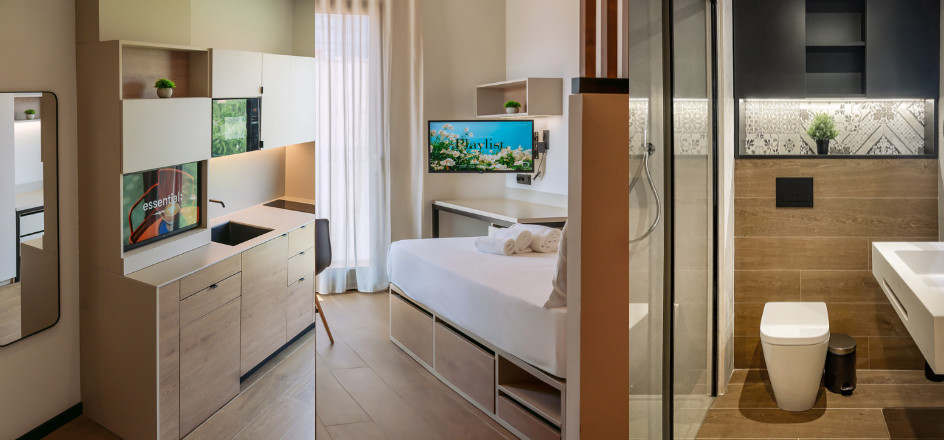
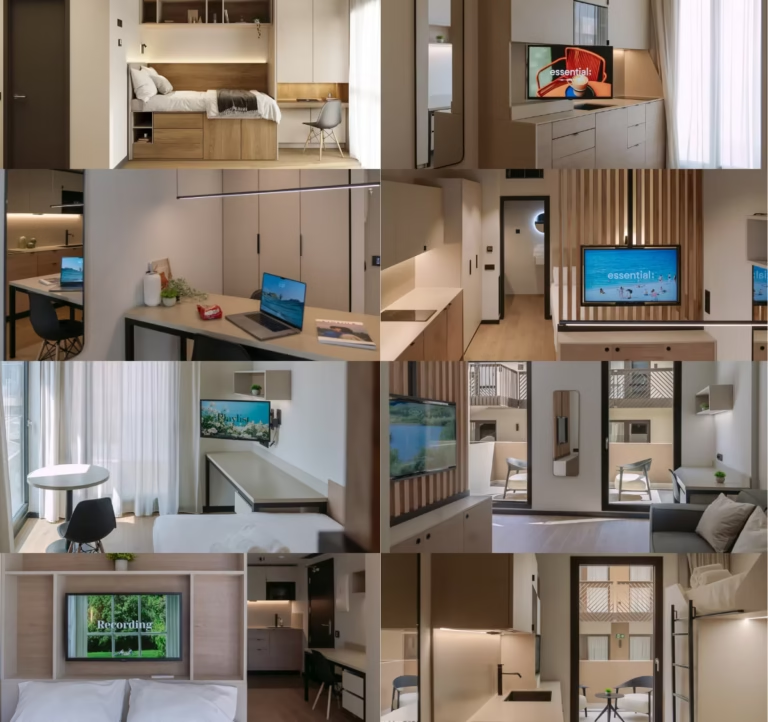
Blau Student Housing is a premium student residence in Poblenou, Barcelona, designed specifically around the needs of international students who want more than just a place to sleep. Every studio at Blau includes a private bathroom, private kitchen, study desk, high-speed Wi-Fi, storage space and climate control — all utilities included, with no variable monthly bills.

Beyond the room itself, Blau provides 24/7 reception, CCTV security, controlled building access and night security staff — giving students and parents confidence in a safe, professionally managed environment. The atmosphere at Blau is intentionally calmer and more mature than party-focused residences: focused on wellness, community, healthy routines and balanced student life.

Throughout the academic year, Blau organizes yoga classes, rooftop events, movie nights, language exchange activities, wellness workshops and cultural activities designed for its international community. These events create a natural social infrastructure — so that students living in private studios are never isolated, even when working independently. Check what's coming up below:

Follow @blaustudenthousing on Instagram to see what daily life at Blau looks like in practice.

Blau is located in Poblenou's 22@ district — one of Barcelona's most internationally oriented and creatively charged neighborhoods, close to universities, design schools, technology institutions and the beach. Discover why so many international students choose Poblenou in Barcelona. For a full overview of commute times to Barcelona's main universities, read the Barcelona universities commute guide.

Private Studios for International Students in Barcelona

Every studio at Blau includes a private bathroom, private kitchen, study desk, Wi-Fi, storage and climate control — all utilities included. 24/7 reception, professional security, wellness facilities and a community of international students in Poblenou's 22@ district.

Follow us on Instagram.

Apply for the Academic Year at Blau →

Student Residence vs Shared Apartment in Barcelona: What International Students Should Know

Student Residence vs Shared Apartment in Barcelona: What International Students Should Know

Barcelona Student Housing

Barcelona Student Housing: Which Option Is Right for You?

Choosing where to live in Barcelona is one of the most important decisions international students make. A shared apartment may seem simple and affordable at first, while a student residence can offer more structure, privacy and support. The right choice depends on your lifestyle, routine and what kind of experience you want during your time in Barcelona.

Interactive Preview

Explore Blau Student Housing in 360º

Before choosing where to live in Barcelona, take a closer look at the spaces, facilities and atmosphere that shape daily student life at Blau.

Open Full 360º Tour →

Why This Decision Matters More Than Many Students Expect

Before moving abroad, many students focus mostly on the university, the course and the city itself. Once they arrive, however, housing quickly becomes part of everyday life: how well they sleep, how far they commute, how easy it is to study, whether they feel safe and how quickly they make friends.

Barcelona is an exciting city for international students. Still, the quality of your living environment can shape your experience much more than expected. In fact, a good housing choice can help you build a routine, feel comfortable in a new country and enjoy the city with far less stress.


Why Many Students Initially Choose Shared Apartments

Shared apartments are a common option for students in Barcelona. For some people, they can work well — particularly if they already know the city, speak Spanish or have friends to live with.

Lower Initial Costs

At first glance, a shared apartment may look cheaper than a student residence. Monthly rent can seem lower, especially when comparing only the room price.

Social Atmosphere

Some students enjoy the idea of living with flatmates, cooking together and sharing daily life in a more informal setting.

More Neighborhood Options

In addition, shared apartments can be found in many different parts of Barcelona, from central areas to quieter residential neighborhoods.

That said, the lowest monthly rent does not always mean the easiest or most comfortable experience, especially for students arriving in Barcelona for the first time.


What International Students Often Struggle With in Shared Apartments

Unexpected Costs

The real cost of renting a shared apartment can include much more than rent. Students may also need to account for deposits, agency fees and utility bills.

On top of that, furniture, kitchen supplies, cleaning products and maintenance costs can add up quickly. If you are comparing options, it helps to look beyond the advertised monthly price. Read more about the real cost of renting an apartment in Barcelona.

Flatmate Compatibility

Living with flatmates can be enjoyable, but it can also be unpredictable. Different schedules, cleaning habits, noise levels and expectations can quickly affect daily comfort.

Furthermore, for students who need a calm environment to study or rest, flatmate issues can become far more stressful than expected.

Loneliness and Isolation

Shared apartments do not always guarantee friendship. In fact, some students live with people they barely see, or with flatmates who already have their own social circles.

As a result, this can be especially difficult for postgraduate students, exchange students or remote learners arriving alone. Learn why many international students feel lonely after moving abroad.

Long Commutes and Daily Fatigue

Some apartments look attractive because they are cheaper, but they may be far from campus or student-friendly neighborhoods. Over time, a long commute can drain energy, reduce social life and hurt productivity.

Therefore, before choosing a place, it is worth thinking carefully about how that daily route will feel after several weeks or months. Explore the best areas for international students in Barcelona.


Why More International Students Are Choosing Student Residences

Student residences are becoming increasingly popular among international students who want a smoother arrival, a more stable routine and a living environment designed around student life.

Private Space and Better Routine

Many students now prefer having their own private space, especially for longer stays. A private bathroom, private kitchen and independent setup makes it easier to sleep well, study and maintain a healthy routine.

As a result, private studios are increasingly attractive to students who want independence without feeling completely disconnected. Find out why more students are choosing private studios.

Managed Living Environment

In addition, a managed student residence reduces many common worries: maintenance, building access, cleaning routines, reception support and general safety. For both students and parents, this kind of structure can make the first months abroad feel far more manageable.

Community Without the Chaos

One of the main advantages of a student residence is the ability to meet people while still keeping personal space. Students can join events, use common areas and connect with others — without depending solely on flatmates for social life.

For many international students, this balance between community and independence is one of the biggest differences compared with a shared apartment. Read how international students make friends in Barcelona.

Study-Friendly Lifestyle

Moreover, a good student residence is not only a place to sleep. It supports a full lifestyle — study areas, wellness facilities and a productive daily rhythm — which can be especially valuable for students who want to enjoy Barcelona while staying focused on their goals.


Which Housing Style Fits Your Lifestyle?

There is no single perfect option for everyone. Instead, the best choice depends on your personality, study program, budget, lifestyle and how much structure you want while living abroad.

Business & Master's Students

Students attending business schools often value privacy, productivity and a calm environment after intense study days. Read the housing guide for ESADE students.

Creative & Design Students

In contrast, design, film and architecture students often look for inspiring neighborhoods and creative energy where they can feel connected to the city. Explore where creative students live in Barcelona.

Exchange Students

Meanwhile, exchange students usually want a balance between campus access, social life, beach proximity and an international community. See where UPF international students usually live.

Remote Learners & Digital Nomads

Finally, remote learners and digital nomads need privacy, reliable routines and spaces that support both focused work and study. Discover housing options for remote learners in Barcelona.


Student Residence or Shared Apartment: Final Thoughts

For students who are independent, already familiar with Barcelona and comfortable managing housing details on their own, a shared apartment can be a practical choice.

On the other hand, a student residence tends to be a better fit for those who want more structure, privacy, support and a smoother transition into life abroad.

Ultimately, the most important question is not only "Which option is cheaper?" — but "Which environment will help me feel safe, focused and happy during my time in Barcelona?"

Explore Modern Student Living in Barcelona

Blau Student Housing is designed for students who want more than just a place to sleep. Located in Poblenou, within Barcelona's 22@ district — close to universities, creative schools, transport, cafés and the beach.

Request More Information →

Living in Barcelona for One Month: Cost & Experience

What Is It Really Like to Live in Barcelona for One Month?

What Is It Really Like to Live in Barcelona for One Month?


For many international students, digital nomads, and travelers, spending a month abroad feels like the perfect balance — long enough to truly experience a city, but flexible enough to fit into a busy life. Barcelona is often at the top of that list thanks to its Mediterranean lifestyle, vibrant culture, and relaxed pace of living.

But what is it actually like to spend one month living in Barcelona?

Beyond photos of beaches and architecture, daily life involves routines, logistics, budgeting, and adapting to a new environment. Understanding what to expect can reduce uncertainty and help you make the most of your time in the city.

This guide explores the realistic experience of living in Barcelona for a month — from lifestyle adjustments to personal growth — and how your living environment can shape the entire experience.

The First Week: Adjustment and Discovery

The first few days in Barcelona usually feel exciting but slightly overwhelming. Even experienced travelers notice small differences in daily life.

Common early experiences include:

  • Adjusting to later meal times
  • Learning how public transport works
  • Understanding neighborhood layouts
  • Managing language differences
  • Adapting to local rhythms

Barcelona operates at a different pace compared to many major cities. Shops may close midday, dinners start late, and social life often happens outdoors. During this first week, most people begin transitioning from “visitor mode” to “temporary resident mode.”

Weeks Two and Three: Creating a Routine

After the initial adjustment period, daily life becomes more predictable. This is when Barcelona starts to feel less like a destination and more like a place you live.

Typical routines might include:

  • Morning coffee at local cafés
  • Study or remote work sessions
  • Exercise or outdoor walks
  • Exploring new neighborhoods
  • Social time with friends

Routine plays a surprisingly important role in well-being abroad. Having a stable base allows you to enjoy the city without feeling constantly unsettled.

This stage is also when many people experience the biggest personal growth — increased independence, confidence navigating the city, and deeper cultural understanding.

The Social Experience: Meeting People in Barcelona

One of the most rewarding aspects of living in Barcelona for a month is the opportunity to meet people from around the world.

The city attracts:

  • International students
  • Digital nomads
  • Young professionals
  • Creatives and entrepreneurs
  • Mid-term travelers

Community-oriented environments make it easier to connect with others, especially for those arriving alone. Feeling socially connected significantly impacts how positive the experience becomes.

Cost Considerations for One Month

Living in Barcelona for one month involves several cost factors beyond accommodation.

Typical expenses include:

  • Accommodation
  • Food and groceries
  • Transportation
  • Leisure and travel
  • Mobile services
  • Insurance

Short-term stays can sometimes feel more expensive than long-term rentals, but they usually offer greater flexibility and fewer administrative complications.

Predictable monthly costs are particularly helpful for international residents managing finances in a new country.

Why Your Living Environment Matters More Than You Think

Where you live during that month strongly shapes your experience.

A comfortable and secure environment can:

  • Improve sleep quality
  • Reduce stress levels
  • Increase productivity
  • Support emotional well-being
  • Make adaptation easier
  • Encourage social interaction

Unstable or uncomfortable housing, on the other hand, can quickly drain energy and negatively affect both work and enjoyment of the city.

This is especially important for digital nomads and students who need both focus and relaxation during their stay.

Experiencing the Barcelona Lifestyle Through Activities

What turns a one-month stay from simple accommodation into a meaningful experience is lifestyle and activity.

At Blau Student Housing, residents have access to experiences that help them connect with both the city and the community.

These include:

  • Weekly yoga classes
  • A running club that goes together to the beach
  • Surf school experiences on Barcelona’s coastline
  • Community and social events

These activities do more than fill free time. They help create:

  • Natural friendships
  • A sense of belonging
  • Healthy routines
  • Stress relief
  • Confidence in a new environment

For people arriving alone in a new country, this kind of community-based lifestyle can significantly improve the overall experience.

A Comfortable Base for Your Month in Barcelona

Blau Student Housing provides an environment designed specifically for people staying in Barcelona for several weeks or months. Private studios with personal bathrooms and kitchens offer independence and comfort, while all-inclusive utilities and high-speed internet create predictable monthly costs without unexpected bills.

Wellness facilities such as gym spaces and a swimming pool help maintain physical balance during your stay, and shared community areas create opportunities to connect with others. A secure and managed living environment also provides peace of mind for international residents and parents supporting students abroad.

Having a stable, comfortable base makes it much easier to enjoy Barcelona while maintaining productivity, routine, and well-being.

👉 Explore Accommodation in Barcelona
https://blaustudenthousing.com/book-now

What You Can Realistically Experience in One Month

A month in Barcelona is long enough to go beyond tourism and experience everyday life.

Possible highlights include:

  • Exploring multiple neighborhoods
  • Developing local routines
  • Visiting nearby cities
  • Meeting international friends
  • Improving language confidence
  • Building independence abroad

Many people find that one month offers the perfect introduction to international living without long-term commitment.

Final Thoughts

Living in Barcelona for one month can be a transformative experience. It offers enough time to build routines, explore the culture, and grow personally while maintaining flexibility. The city’s lifestyle, climate, and international atmosphere make it particularly suited for short- to mid-term stays.

With realistic expectations and a comfortable living environment, one month can feel both exciting and grounding — a meaningful chapter rather than just a temporary visit.

Study and Travel in Barcelona: Is It Possible?

Study and Travel in Barcelona

Can You Study and Travel in Barcelona at the Same Time?

For many international students and young professionals, the idea of combining education with travel is incredibly appealing. Barcelona often appears at the top of that list — a city known for its culture, lifestyle, architecture, and Mediterranean atmosphere.

But a practical question quickly follows:

Is it actually possible to study and travel at the same time in Barcelona?

The short answer is yes — but it depends on how you structure your time, choose your programs, and organize your daily life. With the right approach, Barcelona can offer both meaningful learning experiences and unforgettable travel moments.

This guide explores how to balance studying and exploring the city, and what factors make the experience successful.

Why Barcelona Is Ideal for Study and Travel

Barcelona is uniquely positioned for people who want both education and lifestyle experiences.

Key advantages include:

  • Compact city layout and efficient public transportation
  • International environment with diverse communities
  • Cultural attractions within walking distance
  • Access to beaches, mountains, and nearby cities
  • Weekend travel opportunities across Europe

Unlike destinations where studying requires full isolation, Barcelona naturally integrates learning with daily life experiences.

Choosing the Right Type of Study Program

Your ability to travel while studying depends largely on your schedule.

Flexible programs are typically better suited for combining study and exploration because they allow:

  • Free afternoons or mornings
  • Long weekends for travel
  • Time to explore neighborhoods
  • Opportunities for social activities

Short- or mid-term programs (1 week to several months) often provide more flexibility compared to full academic schedules.

Time Management: The Key to Balance

Balancing study and travel is mostly about planning your time effectively.

Helpful strategies include:

  • Scheduling study sessions in the morning
  • Using afternoons for exploration
  • Planning weekend trips in advance
  • Setting realistic academic goals
  • Avoiding overbooking your schedule

When routines are structured, it becomes easier to enjoy both learning and travel without feeling overwhelmed.

Learning Happens Outside the Classroom

One of the biggest advantages of studying abroad is that learning continues beyond formal lessons.

In Barcelona, daily experiences contribute to personal growth:

  • Practicing language in real situations
  • Navigating transportation independently
  • Meeting people from different cultures
  • Adapting to new routines
  • Building confidence in unfamiliar environments

Travel experiences themselves become part of the learning process.

The Importance of a Stable Living Environment

Combining study and travel requires energy, focus, and organization. A comfortable and reliable home base plays a significant role in making this balance possible.

A supportive living environment helps residents:

  • Maintain consistent routines
  • Rest and recharge between activities
  • Manage schedules efficiently
  • Reduce stress from logistics
  • Feel secure while exploring a new city

Without a stable environment, trying to manage both studying and traveling can become exhausting.

Creating Balance While Living in Barcelona

Blau Student Housing is designed to support international residents who want to combine personal development with lifestyle experiences during their time in Barcelona. Private studios provide independence and personal space, while integrated utilities simplify daily logistics without unexpected bills.

Wellness facilities such as fitness areas and a swimming pool help residents maintain energy and healthy routines. Community spaces also create opportunities to meet people, which can naturally lead to travel plans and shared experiences.

A secure and professionally managed environment offers peace of mind, especially for parents supporting students abroad and for individuals staying several months in a new country.

With a stable living base, residents often find it easier to balance academic goals with exploration and travel opportunities.

👉 Explore Accommodation in Barcelona
https://blaustudenthousing.com/book-now

Tips for Successfully Combining Study and Travel

If you want to maximize your experience in Barcelona, consider these practical tips:

  • Choose flexible programs when possible
  • Plan travel around study commitments
  • Prioritize rest and health
  • Keep realistic expectations
  • Use weekdays efficiently
  • Stay organized with schedules

Balance is more important than intensity.

Final Thoughts

Studying and traveling at the same time in Barcelona is not only possible — it can be one of the most rewarding experiences of living abroad. The city offers a natural combination of education, culture, and lifestyle that few destinations can match.

With thoughtful planning, realistic expectations, and a supportive living environment, you can create a meaningful experience that includes both personal growth and exploration.

Barcelona is not just a place to study or visit — it can become a place where learning and life happen together.

Barcelona Weather Month by Month: Climate Guide

Barcelona Weather Month by Month: Climate Guide

Barcelona Weather Month by Month: What to Expect All Year

If you’re planning to move to Barcelona — whether for studies, remote work, or a temporary stay — understanding the weather can help you prepare better and feel more confident before arriving.

One of the most common questions people ask is:

What is the weather really like in Barcelona throughout the year?

Barcelona has a Mediterranean climate, which means mild winters, warm summers, and plenty of sunshine. However, each season brings its own characteristics that can influence what you pack, how you plan activities, and even how you experience daily life in the city.

This guide explains Barcelona weather month by month, helping international residents know what to expect and how to prepare.

January – February: Mild Winter with Cooler Evenings

Winter in Barcelona is much milder than in northern Europe or North America.

Typical conditions:

  • Daytime: 12–15°C (54–59°F)
  • Evenings: 5–8°C (41–46°F)
  • Occasional rain
  • Mostly sunny days

Snow is extremely rare. However, indoor spaces may feel cooler because buildings are not always heavily insulated. Light jackets, sweaters, and layers are recommended.

March – April: Early Spring and Increasing Sunshine

Spring begins early in Barcelona, bringing longer days and more comfortable temperatures.

Typical conditions:

  • 15–20°C (59–68°F)
  • More sunshine
  • Occasional rain showers

This period is ideal for outdoor activities, walking, and exploring neighborhoods.

May – June: Pleasant and Comfortable Weather

Late spring and early summer are often considered the best months to live in Barcelona.

Typical conditions:

  • 20–26°C (68–79°F)
  • Low humidity
  • Plenty of sunshine

Outdoor dining, beach visits, and city events become more frequent during this time.

July – August: Hot Summer and Beach Season

Summer in Barcelona can be hot, especially during peak season.

Typical conditions:

  • 28–32°C (82–90°F)
  • High humidity
  • Warm evenings

Many residents spend time near the sea or in air-conditioned environments during the hottest hours of the day. Light clothing and hydration are essential.

September: Warm with Fewer Crowds

September often feels like an extension of summer but with more comfortable conditions.

Typical conditions:

  • 24–28°C (75–82°F)
  • Warm sea temperatures
  • Occasional storms

It is one of the most enjoyable months for both residents and visitors.

October: Mild Autumn with Pleasant Temperatures

Autumn in Barcelona remains relatively warm compared to many European cities.

Typical conditions:

  • 18–23°C (64–73°F)
  • Some rainfall
  • Comfortable evenings

This is a popular time for outdoor activities without extreme heat.

November – December: Cooler but Still Comfortable

Late autumn and early winter bring slightly cooler temperatures but still mild conditions overall.

Typical conditions:

  • 12–18°C (54–64°F)
  • Occasional rain
  • Sunny days mixed with cloudy periods

Heavy winter clothing is usually not necessary.

How Weather Influences Daily Life in Barcelona

The Mediterranean climate plays a major role in lifestyle.

Residents often enjoy:

  • Outdoor cafés year-round
  • Walking or cycling as daily transportation
  • Beach activities in warmer months
  • Social gatherings outdoors

For international residents staying several weeks or months, the climate contributes significantly to quality of life and well-being.

Living Comfortably Throughout the Seasons

Weather also affects how comfortable you feel in your living environment. Factors such as air conditioning, heating, indoor facilities, and personal space become important during seasonal changes.

A well-designed living environment can help residents maintain:

  • Consistent routines
  • Physical wellness
  • Productivity
  • Emotional balance

Especially for people adjusting to a new country, having a stable and comfortable home base makes seasonal transitions much easier.

A Comfortable Living Environment in Every Season

Blau Student Housing is designed to provide comfort throughout the year for international residents staying from a few weeks to several months. Private studios offer personal space with a kitchen and bathroom, while integrated utilities simplify daily life without unexpected bills.

Facilities such as fitness areas, a swimming pool, and community spaces support wellness and social interaction regardless of the season. A secure and professionally managed environment also provides reassurance for residents and parents alike.

Having a comfortable place to live makes adapting to Barcelona’s climate — whether summer heat or cooler winter evenings — significantly easier.

👉 Explore Accommodation in Barcelona
https://blaustudenthousing.com/book-now

Final Thoughts

Barcelona’s weather is one of the city’s greatest advantages. With mild winters, warm summers, and abundant sunshine, residents can enjoy outdoor life almost year-round.

Understanding seasonal patterns helps you prepare better, pack appropriately, and plan your lifestyle more confidently. Combined with a comfortable living environment, the climate becomes part of what makes living in Barcelona such a rewarding experience.


When do you

want to stay

Short Stays
Stay up to
6 months
Long Stays
Stay more than
6+months